
Omkeshwar Singh, Head, Rank MF, a mutual fund investment platform, answers your queries.

Ajit Mishra, vice president, Research, Religare Broking, answers your queries.

HDFC Bank, Asian Paints, Kotak Bank, Bajaj Auto and HDFC were among the other laggards.

Ajit Mishra, vice president, Research, Religare Broking, answers your queries.
The central government is importing COVID-19 vaccines and is in talks with COVID-19 vaccine manufacturers Pfizer and Johnson & Johnson, Union Minister of State for Home Affairs G Kishan Reddy said.
With life returning to normalcy gradually, hiring activities grew 24 per cent in September as compared to the previous month mostly driven by pharmaceutical and education sectors, according to a report. At 1,755 job postings, there was an improvement of 24 per cent in hiring activities last month compared to August with 1,413 listings, according to the Naukri JobSpeak Index for September 2020

Ajit Mishra, vice president, Research, Religare Broking, answers your queries

ICICI Bank was the top laggard in the Sensex pack, sinking over 10 per cent, followed by Bajaj Finance, HDFC, IndusInd Bank, Axis Bank and Maruti. Bharti Airtel and Sun Pharma were the gainers in the BSE index. NSE Nifty suffered a heavy loss of 566.40 points, or 5.74 per cent, to settle at 9,293.50.

Omkeshwar Singh, head, Rank MF, a mutual fund investment platform, answers your queries.
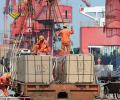
Import segments which recorded negative growth include gold, silver, transport equipment, coal, fertiliser, machinery and machine tools. However, exports of oil seeds, coffee, rice, tobacco, spices, pharma, and chemicals reported positive growth in June.

Sun Pharmaceuticals Industries Ltd has posted a 45.01 per cent rise in its consolidated net profit at Rs 358.9 crore (Rs 3.59 billion) for the financial year 2003-04 as against Rs 247.5 crore (Rs 2.47 billion) in 2002-03.
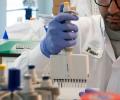
Two men, aged 32 and 48, were given the first shot of the 'Covishield' vaccine, being manufactured by Pune-based Serum Institute of India, at Bharti Vidyapeeth's Medical College and Hospital on Wednesday. The dose will be repeated after one month, an official said.

The announcement comes a day after the Subject Expert Committee (SEC) on COVID-19 of the CDSCO recommended granting emergency use authorisation (EUA) to the COVID-19 vaccines Covovax and Corbevax with certain conditions.
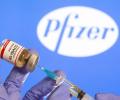
An expert panel of the country's drugs regulatory authority had recommended against granting such approval to the firm at this stage just two days ago, officials said.

ICICI Bank was the top loser after the private lender reported sharp drop in Q4 net.
Releasing a report titled 'Profiting from Pain' in Davos, the rights group further said as the cost of essential goods rises faster than it has in decades, billionaires in the food and energy sectors are increasing their fortunes by $1 billion every two days.

Easier dilution norms for mega initial public offerings (IPOs) have come into effect. Companies with post-listing market capitalisation (m-cap) of more than Rs 1 trillion will not be required to dilute a minimum of 10 per cent. The move to relax dilution norms is seen as a precursor to Life Insurance Corporation's IPO. The central government has said companies with an m-cap exceeding Rs 1 trillion will have to dilute Rs 5,000 crore and at least 5 per cent of their m-cap. Experts said the earlier framework discouraged large companies from listing since they were forced to offload a large volume of shares during the time of their IPO.

Sectoral performance was mixed with media and PSU banking stocks attracting buyer interest and healthcare, FMCG and metal stocks bearing the brunt of the bears

'Investors should be careful in getting carried away; although a reversal of IPO frenzy this time is taking longer than in the past.'

Lashing out at the micro-blogging platform over non-compliance, Prasad said that it is "astounding" that Twitter that portrays itself as the flag bearer of free speech, chooses the path of deliberate defiance when it comes to the intermediary guidelines.
'The government should put the whole road map together for the vaccine and decide how industry can support...' 'They should allow the private sector to vaccinate.'

Business executives are finally dusting off their long-unused suitcases to resume travel, thanks to a good vaccination rate, a drop in fresh cases, and an easing of travel restrictions. It comes as a huge relief for the ravaged aviation, travel and hospitality sectors. "We are witnessing a 40 per cent recovery on pre-covid volumes from our business travellers, signalling the return of corporate confidence in air travel," said Indiver Rastogi, president & group head, Global Business Travel, Thomas Cook (India) & SOTC.

'I hope the trend is sustainable and that economic activity accelerates going forward.'

Ajit Mishra, vice president, Research, Religare Broking, answers your queries.

M&M was the top gainer in the Sensex pack, soaring around 7 per cent, followed by Bajaj Finserv, Bharti Airtel, PowerGrid, Infosys and ICICI Bank. On the other hand, HUL, Kotak Bank, Bajaj Finance and ITC were among the laggards.

Ajit Mishra, vice president, Research, Religare Broking, answers your queries.
Sun Pharma stock has appreciated at 35% a year for 20 years

In the Sensex pack, Bajaj Finance and Bajaj Auto ended up to 6.09 per cent higher after posting strong quarterly numbers.

TCS was the top gainer in the Sensex pack, rising around 4 per cent, followed by ONGC, ICICI Bank, HDFC Bank, Dr Reddy's, HDFC and HCL Tech. NSE Nifty advanced 76.65 points to 14,581.45.
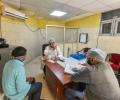
The current crisis has forced the government to announce measures to ensure that India becomes self-sustaining for any kind of bulk drug. The government says India will not depend on any other country for vital key ingredients for drugs within six years, reports Sheela Bhatt.

"It is a matter of pride for us that India's vaccination programme has been science-born, science-driven and science-based," Modi said.
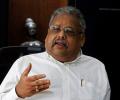
Jhunjhunwala holds a stake in more than 30 listed firms.
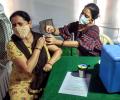
So far, no other vaccine has been approved globally for children below 12 years. Sohini Das reports.

Sun Pharma expects synergy benefits by next fiscal.
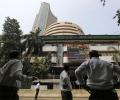
TCS emerged as the biggest gainer among the top-10 firms
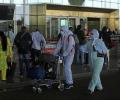
British nationals arriving in India, irrespective of their vaccination status, will have to undergo 10 days of mandatory quarantine from October 4 as part of the reciprocal actions initiated by the government following the vaccine certification row between the two countries.

Sentiment also remained buoyant as a good monsoon season lifted hopes of a revival in farm output.

At least two key drugs in the gliptin category have already gone off patent and cheaper variants are crowding the market. Also, several patent expiries are round the corner for the newest category of drugs - SGLT-2 inhibitors or gliflozins.

Omkeshwar Singh, head, Rank MF, a mutual fund investment platform, answers your queries.
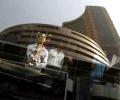
After swinging 439 points during the day, the 30-share Sensex ended 141.33 points, or 0.38 per cent, lower at 37,531.98. It hit an intra-day low of 37,480.53 and a high of 37,919.47.
 © 2026 Rediff.com - Advertise with us - Disclaimer - Privacy Policy - Sitemap - Feedback - About us - Terms of use - Grievances